

Most Popular
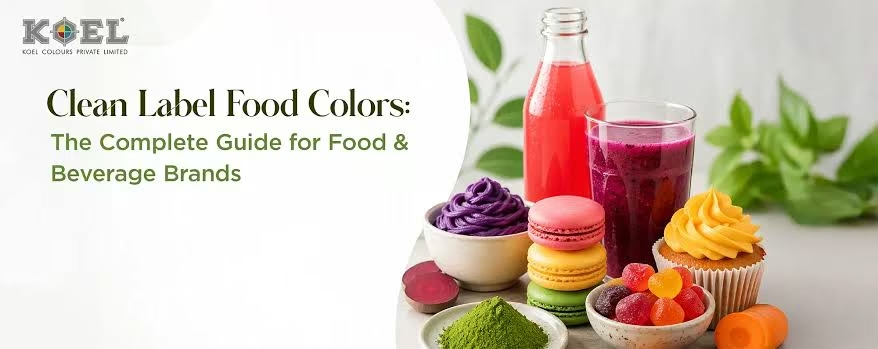
Clean label food color trends in today’s climate of growing consumer education about food components, companies have increasingly been challenged to provide product that is aesthetically pleasing while also clearly communicating their formulation. The clean label trend for food colorants is a response to this demand. Manufacturers face challenges in meeting consumer demands with respect to color quality and regulatory compliance.
A “clean label” colour is one that is based on a natural source, has been minimally modified chemically after extraction and is easily recognizable by consumers as part of an everyday ingredient.
In other words, they have no resemblance at all to synthetic colours (produced using chemicals) and even less so than many natural colours that have undergone considerable chemical manipulation prior to use.
The clean label colour movement focuses on maintaining ingredient visibility & simplicity.
Examples include: turmeric (yellow), beetroot (red), spirulina (blue), paprika (orange).
Clean Label has no defined international terminology, yet it can be summarized by commonalities in three key areas.
The terms “natural”, “organic” and “clean label” are often confused with one another. Although natural products come from nature, they can also undergo some degree of processing. Organic is an agricultural practice. In contrast, “clean label” emphasizes consumer perceptions and product labeling.
In addition to increased health and transparency for consumers when it comes to their food, there has been an increase globally of more stringent regulations and more active consumer influence as well as social media, which is resulting in the trend towards cleaner label formulations on behalf of manufacturers. Manufacturers are now using alternatives to traditional synthetic dyes for coloration. These alternative coloring agents will be compliant with clean labels.
Yellow shades may be derived from Turmeric or Curcumin, therefore they are quite popular within Snack, Dairy and Bakery markets.
Annatto and Paprika are a couple of examples that produce great Orange colors with some level of heat resistance.
Anthocyanins and Beetroot juice will often color Red/Pink but have varying levels of pH sensitivity.
Chlorophyll-based coloring agents like Spinach juice produce Green hues; however, the agents require extra care due to instability.
Spirulina extract is one of the most viable Blue coloring agents available today, ideal for clean label formulas.
Caramel alternatives made with Cocoa, as well as Cocoa itself, are used to create Brown and Black tones.
While beneficial, clean label colours come with certain formulation challenges:
These factors require careful product development and expert support.
| Factor | Impact on Performance |
| pH Sensitivity | Influences colour shade, especially reds and purples |
| Heat Stability | High temperatures may degrade pigments |
| Light Stability | UV exposure can lead to fading |
| Storage Conditions | Temperature and humidity affect shelf life |

Used in cakes, icings, and fillings to create appealing visuals with natural positioning.

Applied in ice creams, yogurts, and flavored milk products.

Common in juices and ready-to-drink formulations.

Used in gummies, candies, and decorative coatings.

Suitable for chips, seasonings, and extruded snacks.
| Aspect | Clean Label Colors | Artificial Colors |
| Source | Natural | Synthetic |
| Stability | Moderate | High |
| Cost | Higher | Lower |
| Consumer Perception | Positive | Declining |
| Regulatory Acceptance | Increasing | More regulated |
The regulatory body, FSSAI, in India that sets regulations on what can be used as a food color and requires labeling to demonstrate compliance with those standards. In comparison, both the European Union and the United States are becoming increasingly restrictive in their use of artificial colors. Due to this trend toward natural colors, we believe that these environmental conditions will continue to influence product development using clean label compliant food colors.
Working with an established manufacturer such as Koel Colours can assist brands in identifying a combination of natural, nature-identical, and synthetic alternatives that best suit their product’s performance objectives and their labelling objectives.
Clean label food colours will be driven by technological advancements. Technologies currently being developed, including fermentation based pigment production and enhanced extraction processes, will improve upon current issues of light stability and large-scale commercialization. In addition, the increasing demand for more rare colours (i.e., green and blue) will also fuel additional product innovation and development.
Natural colours come from nature, while clean label colours emphasize minimal processing and consumer-friendly labeling.
Some are stable, but performance depends on the specific ingredient and processing conditions.
Yes, provided they meet regulatory guidelines and permitted usage levels.
Generally, no, though high concentrations may slightly influence flavor.
Due to sourcing, processing complexity, and lower stability compared to synthetic colours.
Clean Label is an evolving expectation in the marketplace; therefore, as you look to adopt compliant solutions that will allow your brand to remain ahead of competition, Koel Colours has developed a full range of Natural, Synthetic and Blended Food Colour solutions supported globally through certification and technical expertise. Contact the team to discuss how we may be able to develop customized solutions or provide complimentary product samples for your next formulation.